librelane.org
Introducing the brand-new LibreLane website! We're hoping that this website serves as a friendly introduction to LibreLane – its capabilities, design principles, and community. This website – and our beautiful new logo by Jon Walters – mark us fully settling in in our home at the FOSSi Foundation.
It has been a long journey. From the shutdown of Efabless, to the forking of OpenLane 2, to setting up all of our development infrastructure – until we finally could work on new LibreLane features and improvements again.
And we have been busy…
LibreLane 3.0
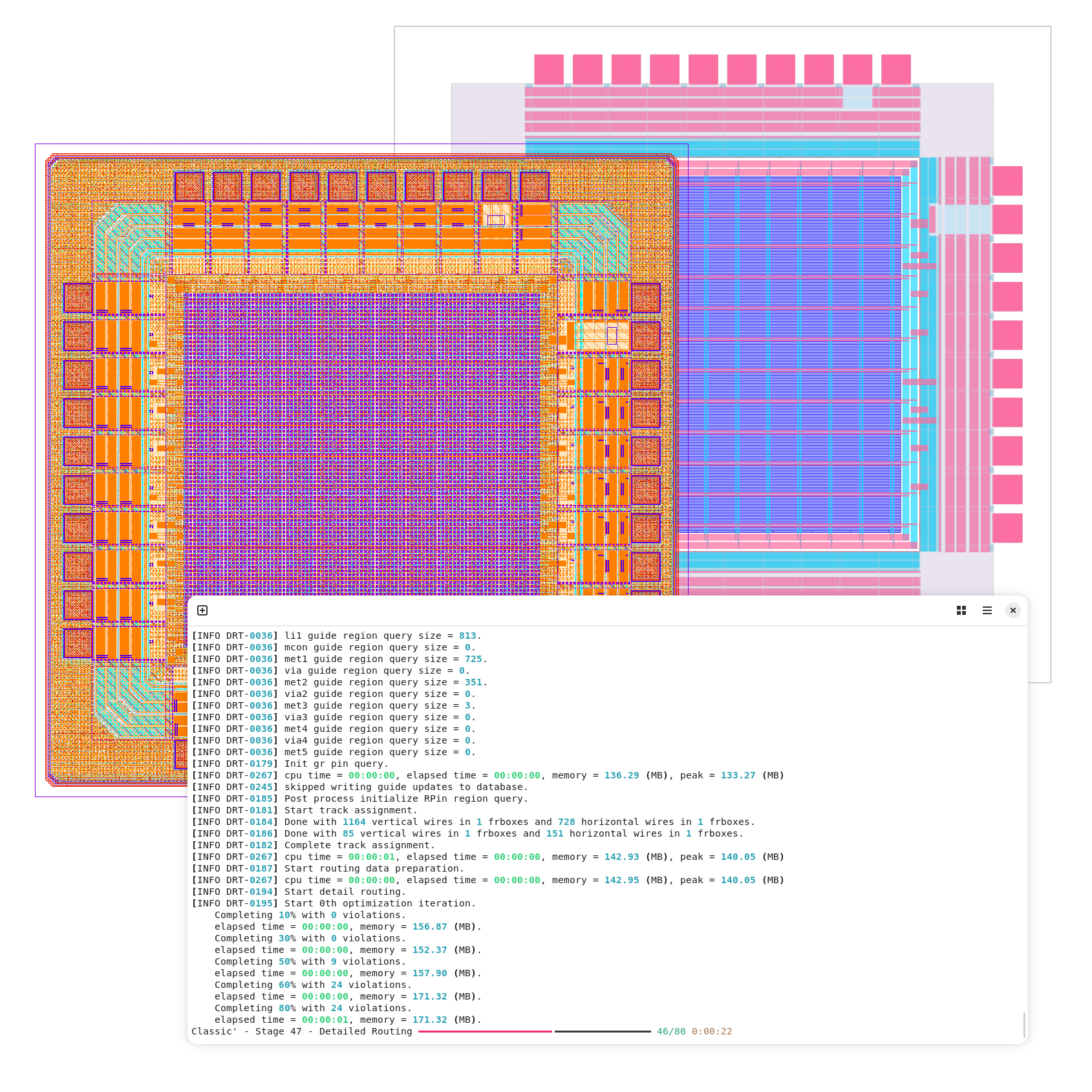
We are proud to finally release LibreLane 3.0.
This is the second major version release for LibreLane and our first outside of Efabless. It has been in development for a fairly long time, and is packed with new features, enhancements, support for new technologies, and more, and our first API cleanup (which is what actually caused the major version bump, but the features are worth talking about too, promise.)
Some highlights are as follows:
The Chip Flow
Alongside our trusty
Classic flow,
based on OpenLane which is used to harden macros for implementing into larger
chips such as Tiny Tapeout or
Caravel, we're introducing a new
built-in flow named Chip, built by LibreLane maintainer Leo Moser.
This new flow is intended for the tape-out of top-level chips, eschewing the generation of top-level pins and adding long-requested new pad ring generation functionality. A number of new steps have been added to support this, including:
OpenROAD.PadRing: Generates the pad ring itself using OpenROAD.KLayout.Density: Performs a density check on the final GDSII for supported PDKs.KLayout.SealRing: Generates a seal ring around the chip for supported PDKs.
This flow has in turn been used to enable designs that use LibreLane on two new shuttles:
- The IHP Shuttles: support for top-level chip tapeouts on both the ihp-sg13g2 and the brand new ihp-sg13cmos5l open-source PDKs using these templates:
- wafer.space: Top-level tapeouts on the gf180mcu PDK using this template: https://github.com/wafer-space/gf180mcu-project-template
IHP support for LibreLane was implemented in part by the Tiny Tapeout team, who we thank dearly.
Custom Flow and Plugin Updates
LibreLane 3.0 also includes some small tweaks to enable easier creation of custom flows. The two biggest ones are to Design Formats and step substitution.
Design Formats are how LibreLane represents the various file types that hold
information about your design. For example, nl is a DesignFormat with the
human-friendly name Verilog Netlist. A floorplanning step, for example, takes
an nl DesignFormat and returns a def DesignFormat.
Until LibreLane 3.0, these design formats were part of a fixed enumeration. Meaning if you had a new tool that uses one or more new file types, you would not be able to use them with LibreLane.
In LibreLane 3.0 and higher, you can now register new design formats for your
custom flows. For example, if someone were hypothetically working on a
design-for-test plugin, and said plugin requires circuits to be transformed into
the bench format as part of the DFT flow, the new format would be registered
and used as follows:
DesignFormat("bench", "bench", "DFT Bench Format").register()

@Step.factory.register()
class WriteBench(Step):
  # …
  outputs = [DesignFormat.bench]
This allows for a lot more flexibility when creating custom flows.
Similarly, step substitution is a simple but powerful feature in LibreLane that lets you create a custom flow by modifying an existing flow, which is accessible from either Python code or from the very same design configuration file you use for everything else.
For example, a design with this substitution would delete all
OpenROAD.STAMidPnR steps from a flow, and replaces Yosys.Synthesis with
Yosys.Resynthesis, which instead of using the VERILOG_FILES variable instead
uses a pre-existing netlist in the state dictionary:
meta:
  flow: Classic
  substituting_steps:
    - ["OpenROAD.STAMidPnR*", null]
    - ["Yosys.Synthesis", "Yosys.Resynthesis"]
An issue that plagued this feature in LibreLane 2 however was that Step IDs were not recomputed after each substitution. This made it very cumbersome to "chain" substitutions, such as with the same hypothetical plugin:
@Flow.factory.register()
class DifettoPNR(Flow.factory.get("Classic")):
    Substitutions = [
        ("Yosys.Synthesis", "Difetto.Synthesis"),
        ("+Difetto.Synthesis", "Difetto.BoundaryScan"),
        # …
    ]
In LibreLane 2, this would fail as it would not recognize Difetto.Synthesis as
a valid step ID already in the flow. In LibreLane 3.0, this now behaves as you'd
expect, which is, ironically, a breaking change.
This enabled us to introduce our two most complex plugins yet, namely:
- Difetto: A not-actually-hypothetical but still work-in-progress design-for-test flow that is implemented as a LibreLane plugin, leveraging all-open-source utilities, both already available and developed ad-hoc.
- FABulous LibreLane Plugin: A plugin that adds two new flows in order to implement and stitch tiles into an FPGA fabric, using LibreLane and the FABulous embedded FPGA framework.
We would love it if you too would try your hand at implementing custom LibreLane flows and plugins. Guides on writing custom flows, custom steps, and plugins are all in the LibreLane Usage Guide in the documentation.
Other
We've updated the tool environment to be based on NixOS 25.11, and included more
up-to-date versions of tools across the board for the Classic and Chip
flows. As usual, each update cleared our meticulous CI, which we've enhanced
further for 3.0, for all PDKs to ensure you're still receiving a first-class
chip experience.
Additionally, we've updated the Nix recipes to support loading user-defined Yosys plugins and add user-defined Python packages to Yosys/OpenROAD Python interpreters. This is useful for some custom flows - for example, in Difetto, we required OpenROAD and Yosys scripts to use a number of Python libraries that weren't included with LibreLane.
And of course there many other many small improvements, such as improved rendering of the chip layout, reduced file size for both Magic and KLayout GDS files, better subprocess formatting, and many more improvements and bug fixes, including new features and improvements from updating OpenROAD such as support for non-default rules and much-improved antenna violation fixing.
Above all else, we would like to thank our community for your continued support of LibreLane. We'd like to extend special thanks to (in alphabetical order):
- our Contributors for submitting fixes, feature ideas, and many other things that make LibreLane even better.
- the FOSSi Foundation for giving the project a home after Efabless was wound up.
- Kareem Farid - for his work on what were OpenLane 2.0 and the OpenLane 3.0 alpha back at Efabless.
- Mohamed Kassem, Jeffrey DiCorpo and other Efabless alumni – who were the first adopters of OpenLane 2 and who later supported us moving to LibreLane under the FOSSi Foundation, and let us set up soft redirects for our various projects.
- Mohamed Shalan – for starting OpenLane and supervising the initial development of LibreLane.
- Tim Edwards – for his help updating and bringing up the various PDKs while maintaining LibreLane compatibility.
- the Tiny Tapeout team – for their continued use of LibreLane as the primary flow for user projects, and for help bringing up the first IHP Open PDK.
See the full release notes here: https://github.com/librelane/librelane/blob/3.0.0/Changelog.md
Install LibreLane today!